
Garment manufacturing has always learned from previous work from the beginning. Real-time production visibility helps manufacturing teams identify issues while production is still ongoing. The line supervisor knows about the shop floor issues when the shift has already ended. The planner knows about the order delay when there are no products to pack at the packing plant. The vendor only knows about the quality defects when the buyer’s quality assurance team rejects the product at the final examination.
The information arrives too late when the delay has already happened and nothing can be done about the betterment, but still, all the information is correct.
For a very long period of time, this same work process was acceptable. At that time, trends and styles were not changing even for months, and manufacturing times were also at ease. But that time is already gone. Nowadays, orders are not that big, styles and trends are changing frequently, brands want products faster, and buyers also want to know and seek information about each garment. The new factories that are successful these days are those that have adapted to the technology and are not working with or using the old or manual methods.
The Cost of Delayed Information Without Real-Time Production Visibility
Suppose a sewing floor with 2,000 machines is making many designs across several lines.
After doing all the work, at the end of the day, you will get only one figure: total output. That number will tell you the status of whether you have fulfilled the target or not. It doesn’t give you the information on where each minute was spent during production.
Think like that: if one operation is taking an extra twenty seconds, it is impossible for you to see it on a daily basis. With the passage of time, throughout a full shift, over a month, that small gap will cost you more than you think without anyone noticing it.
Another example is if one workstation is slow, and just because of that, the other four operations will also stop. The final report will show that we did not complete today’s target. And the most common answer will be to work harder tomorrow. But the real solution is not working hard. The main problem is that the workstation is slowing down the whole production flow. If that problem is showing, the team can do better work at the station and will improve the complete line.
This is the main drawback of old-style reporting. It informs you what happened but never tells you why. And when you start asking why, at that time, the situation that is causing the issue is already gone.
This is the main drawback of old-style reporting and the reason real-time production visibility matters. It informs you what happened but never tells you why. When you start asking why, the situation causing the issue is already gone.
What Real-Time Production Visibility Means on the Factory Floor
People usually use this phrase, so let’s be clear about the actual meaning inside a factory.
Before reaching the line, every single piece has been assigned an ID. This process starts from cutting. Each cutting bundle receives a card with PO, style, cut and bundle number. And from that point, the bundle has a proper identity, and the whole factory follows it.
Each step in work is recorded by the small device at every machine. The operator scans their card, so then the system knows who is working right now. All the work is recorded and done, not written manually or typed at night.
The data is transferred from the floor instantly. Wireless devices collect data from the floor and send that data into the database within seconds. This real-time production visibility allows teams to see what is happening on the factory floor while there is still time to respond.
The operator can also see that, and most factories don’t focus on this part. While this is the part that changes the behaviour. When a worker sees their daily wages against their work and the number of pieces they worked on, the system will start feeling like feedback and doesn’t look anymore like watching. Operators can correct themselves and improve efficiency. Payroll arguments almost disappear.
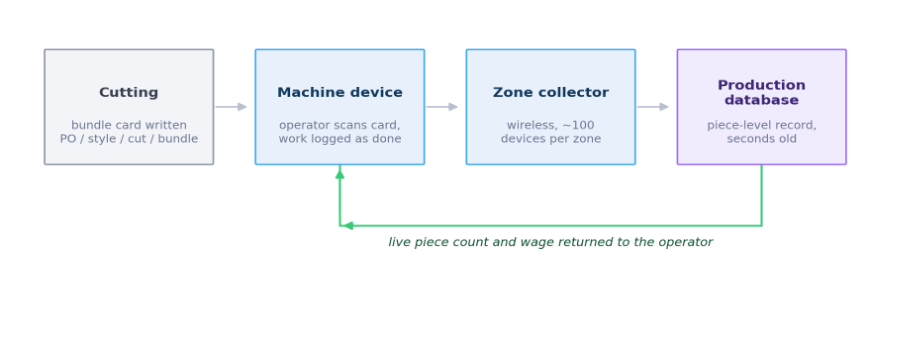
The main part that matters is the loop back to the operator. The data that is travelling upward is called monitoring. The data that travels back down is called feedback.
Connecting is the place where the value is found.
This is something that most factories only learn after several years. Each module provides a slight improvement. You get a nice big one from connected modules.
Even an RFID system to monitor rolls and allocate them to orders is helpful in the fabric warehouse. It becomes far more beneficial when the width variations in the roll are incorporated into the layering plan and the cut plan — not only are you able to track fabric, but you are also saving fabric before cutting takes place.
The use of quality tracking on its own is useful. If there’s a growing number of defects, it can be tracked back to one operation, one operator, one bundle — and one roll of fabric or one machine setting!
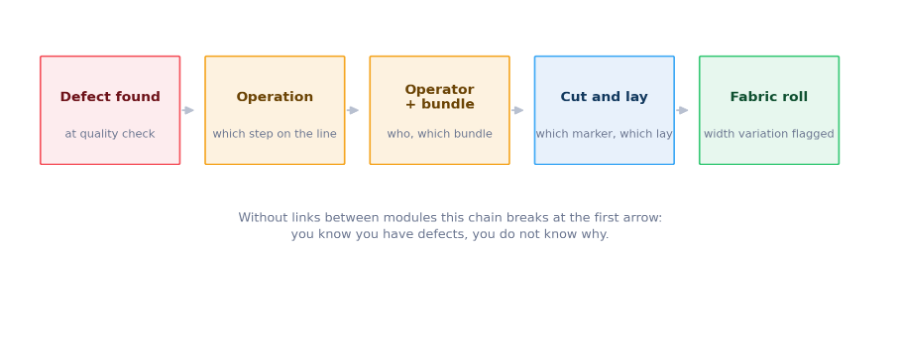
The most obvious example is packing. Wrong-size, wrong-style shipments just don’t occur again when each garment is scanned against its EPC at packing and checked against the order. It’s a very costly and damaging mistake that can be eliminated from a manufacturer’s repertoire.
There can be a 30–50% boost in efficiency in factories that are linked throughout the entire cut-to-pack process. That number is what they hear, and they think that it is from the sensors. It does not. It derives from a supervisor being able to identify the cause of a problem as it is occurring — and resolve it. Repeat this many times each week, and you see how it works!
Why the Need for Real-Time Production Visibility Is Growing
The time lag is decreasing. Brands are looking for quick delivery and frequent small orders. Smaller orders = a higher number of style changes — and it is the factory without visibility that loses the most time in the process of changeover.
There are rules on traceability that are coming. The EU’s Digital Product Passport will demand data for each product regarding materials, origin and production. If a factory is already tracking at the level of individual pieces using unique IDs, then it’s almost there. A factory that operates with spreadsheets and end-of-day totals will need to start from scratch, with a deadline.
Brands expect more. Buyers are looking for supplier performance to be visible, not through a monthly report. Those manufacturers that are willing to provide real, reliable data are easier to deal with and, inevitably, that means gaining orders.
The mistake I made, and the one the industry is making now
It’s fair to say I want to be honest, and I believe that all of our industry is walking into this blind.
When Dashboards Are Not Enough
My gut feeling for years has been that if I can see it, then I can show it. The more the supervisor could see, the more the supervisor would do. So, we created additional views, charts and drill-downs. And the dashboards were found to be good. However, if no one uses a dashboard, it is a very costly way to describe a problem.
AI Needs Logic, Not Just Faster Reports
But now the time has come when AI is here, and we’re making the same error in a new guise. What I see to be most prevalent in our industry is using AI to produce dashboards automatically — the same reports, but done with less effort and more quickly. That’s the least interesting aspect of technology.
The important thing is logic. The question isn’t, “I could have AI create a chart of today’s efficiency.” So the question posed is: Is it reasonable to assume that the fabric for this cut was sourced from a roll that had a known width variation, that the inline audit pass rate for this operation has decreased since the morning, and that this PO is scheduled for delivery in 9 days? What needs to be done, who needs to do it and when?
That’s the sort of work that an experienced industrial engineer does in their head. It’s the work that’s lost when someone takes leave, when someone moves to another factory, when someone has so many lines to cover that she doesn’t have time to see any of them.
From Isolated Data to Assigned Action
Therefore, the architecture we’re creating is not a reporting stack. Each of the following applications exposes its data in isolation: Production, Quality, Pre-production workflow and Order info. A reasoning layer traverses the four, since none of the modules can tell you whether a shipment is at risk. It identifies the operator, machine and operation fault conditions. It takes into account the time that has elapsed from the ex-factory date. Then it chooses what really is worth their while and passes it on to a named entity: quality, production, maintenance, HR or admin.

Point out the missing component of that drawing. There’s no button that says, “Look at the Dashboard.” No one should be reminded to look for anything. The system concludes there is something amiss, concludes an owner, and passes it on.
Insightful dashboards don’t bring results. What happens to the data is what matters — actions are what produce results. Each new layer between the data and the decision is a layer in which the improvement sneaks away.
Where to begin
The temptation is to begin at the top of your list. It’s better to begin at the source of identity, bundle tracking. The next thing after the work in progress has no identity, it’s an estimate. After the bundle is given an identity, the data is meaningful for sewing, the quality data is traceable and pack verification becomes possible.
There are two factors more important than the technology you select.
Infrastructure. Before anyone could imagine, the design of the database and network are the limitations. If every operation on every piece of data is recorded in a factory, where there are thousands of machines, a schema that was not designed well will not stand up to that data. This is something we found out the hard way a few years back.
Those who take action with it. Data is nothing but dashboards without someone knowing what to do with them. This is the part that you can’t buy, and more and more, the part you’d like to teach the machine.
Real-time visibility isn’t a better report. The difference between explaining yesterday and changing today — unless someone changes something, of course.
Frequently Asked Questions
Real-time production visibility is the ability to track production activities, work-in-progress, quality and operational performance as they happen instead of relying only on end-of-day reports.
It helps manufacturers identify bottlenecks, delays and quality issues earlier, allowing teams to take corrective action before they affect production targets or delivery schedules.
Bundles or individual pieces are assigned unique identities and their movement and production activities are recorded digitally. Technologies such as RFID, IoT devices and connected production systems can transfer this information from the shop floor to a central system in real time.
Traditional reporting primarily explains what has already happened. Real-time production visibility shows what is happening now, helping teams identify problems and respond while there is still time to influence the outcome.
AI can analyze production, quality, workflow and order data together to identify patterns, detect risks and prioritize issues that require action. Its usefulness depends heavily on having accurate and timely shop-floor data.