
Without complete data, finding the root cause can be challenging and may take hours or even days. Instead of responding after the loss has occurred, factories need technology that helps prevent problems. This is where AI in apparel manufacturing, supported by AI-powered production intelligence, can transform factory operations. Instead of asking only, “What happened?”, factories can start asking: “How can we prevent this from happening?” “Where are the bottlenecks?” and, most importantly, “What should we do about it?”
Where Are Apparel Factories Losing Money?
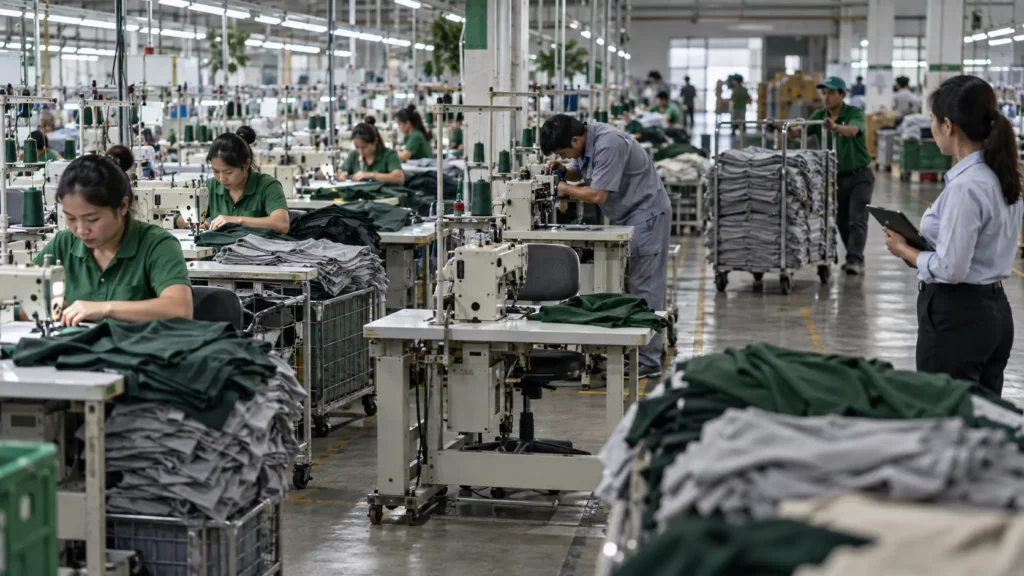
Most companies focus on producing more, sometimes by increasing manpower. As a result, costs increase. The biggest opportunity is to eliminate hidden losses. Consider a typical apparel factory. Costs can increase because of:
- Poor production planning
- Incorrect line loading
- Low sewing efficiency
- Unbalanced operations
- Excessive WIP
- Machine breakdowns
- Quality defects and rework
- Excessive overtime
- Material shortages
- Long changeover times
- Underutilized manpower
- Late approvals
- Poor coordination between departments
- Delayed decision-making
Individually, if we investigate the percentage of every type of downtime, each may look small. Collectively, however, these losses occur every day across multiple lines and have a huge impact on the company’s financial performance.
AI Can Turn Factory Data into Decisions
Fortunately, technology is evolving, and modern apparel factories already have enormous amounts of data. Production reports contain all the necessary information about output, efficiency, manpower, and other factors. IE teams have SAM and operation data. Quality teams record defects. Maintenance teams record machine downtime. Planning teams maintain order and capacity information.
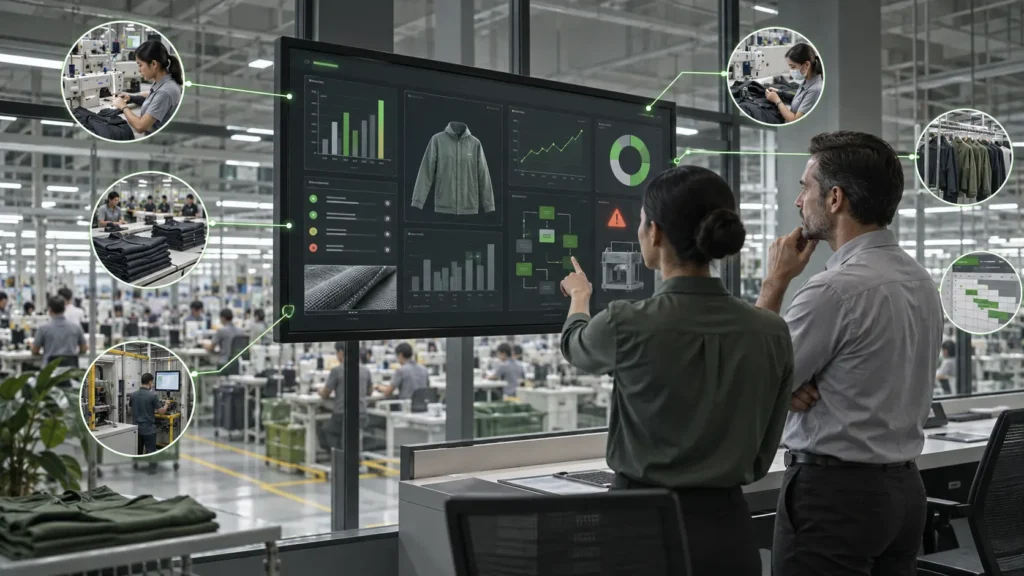
The problem is often not the absence of data. The problem is that the data is disconnected. This is where the role of AI-powered production intelligence begins. It brings this information together and converts it into meaningful insights for greater visibility and faster decision-making.
For example, instead of simply representing data and showing that Line 4 achieved 56% efficiency, an intelligent system could analyze the production data and identify whether the major loss came from a bottleneck operation, absenteeism, or repeated machine downtime. It could then recommend specific actions. This shift will change the role of technology from reporting to decision support without wasting time on problem identification.

How AI in Apparel Manufacturing Improves Production Planning
One of the most practical applications of AI in apparel manufacturing is improving production planning and capacity utilization. Production planning is the brain of every organization. It drives the whole plant. This is one of the core areas where AI can create a significant impact. Traditional planning often depends heavily on historical experience and manual calculations. However, production decisions involve hundreds of variables: order quantity, SAM, product complexity, line capability, manpower, efficiency, material availability, delivery dates, and changeover requirements.
AI can analyze these variables simultaneously. It can help answer questions such as:
Which style should be loaded on which line?
Can the factory achieve the required shipment date?
Where will capacity become a bottleneck?
Which orders are at risk?
What will happen if one line goes down?
This will help teams make decisions faster and eventually lead to maximum capacity utilization.
AI-Powered Line Balancing
Line balancing is another major opportunity. Usually, all lines on the production floor are equipped with the necessary skills and manpower, but they sometimes fail to deliver the required results. The reason for this inefficiency is that one or two operations create a bottleneck.
Normally, operations are assigned and lines are balanced when the style bulletin is created. However, actual scenarios are different from what was planned. Operators have different skill levels. Absenteeism occurs. Machine performance changes. Product characteristics vary. A plan may change from the initially selected line to another line.
AI can continuously compare planned SAM and capacity with actual production performance. It can identify and raise an alert when WIP is accumulating and recommend manpower or operational adjustments. The objective is simple: Right person + right operation + right machine + right time. This can improve productivity without simply adding more manpower.
AI in Apparel Manufacturing for Predictive Quality
Quality is another area where AI can play a vital role. Traditional quality systems often identify defects after they occur. But what if the factory could identify the risk of a quality problem before it occurs? AI can analyze defect patterns by style, operation, operator, machine, shift, and time.
For example, if a particular operation suddenly shows an increase in defects, the system will record the abnormality and help the team investigate the possible root cause.The goal is not to replace quality inspectors. The goal is to move from: “Find the defect.” to: “Prevent the defect.” That shift can reduce rework, rejection, and alteration, ultimately lowering manufacturing costs.
Predictive Maintenance
Machine breakdowns directly affect production efficiency and delivery performance. The traditional approach is simple: Machine breaks → Maintenance responds. AI enables a more proactive approach: Machine behavior changes → System identifies risk → Maintenance acts before failure. By analyzing maintenance history, downtime patterns, and machine performance, intelligent systems can help identify machines that require attention. Even reducing a small amount of unexpected downtime across dozens or hundreds of machines can create a meaningful production benefit. AI will also create a databank and help identify the relevant person responsible.
Managing People More Intelligently
In apparel manufacturing, people will always remain one of the most important assets. AI can help factories understand the relationship between skills, efficiency, quality, and operations, but it cannot replace human assets. A digital skill matrix can identify which operators are capable of performing multiple operations and where skill shortages exist. This can support cross-training, better manpower allocation, and greater workforce flexibility.
Instead of asking: “How many operators do we have?” management can ask: “Do we have the right skills in the right place?” That is a much more powerful question. There is a myth that technology will reduce manpower. In fact, technology will help people work smarter.
The Future of AI-Powered Apparel Manufacturing : A Production Control Tower
The ultimate goal should not be hundreds of separate dashboards. It should be a Production Control Tower. Imagine a factory manager starting the day and seeing:
Production — Green
Efficiency — Amber
Quality — Green
Delivery — Red
WIP — Amber
Capacity — Green
The system then highlights the top risks:
- Order A may miss shipment
- Line 7 is below expected efficiency
- Washing capacity is becoming a bottleneck
- Style B has a material risk
- Machine X requires maintenance attention
More importantly, the system recommends actions. This is the real meaning of production intelligence.
From Cost Reduction to Competitive Advantage
We need to shift our mindset away from simply reducing labor costs or increasing working hours. In the future, only factories that produce faster, smarter, more consistently, and with less waste will remain competitive. AI-powered production intelligence provides a path toward that future. The objective is not to create a factory full of technology.
The objective is to help a factory and its management ensure that every important decision is supported by reliable data and intelligent analysis. The transformation can start small: production visibility, capacity planning, line balancing, and loss analysis. Once the foundation is established, process optimization will automatically begin. The ultimate question for apparel manufacturers is no longer: “Can we afford to invest in AI?” It will soon become: “Can we afford to continue making production decisions without it?”
Frequently Asked Questions
Yes. AI can compare planned capacity and SAM with actual production performance. It can identify bottleneck operations, WIP accumulation, absenteeism, machine downtime, and other factors that may reduce sewing-line efficiency.
AI can analyze defect patterns by style, operation, operator, machine, shift, and time. This helps quality teams identify unusual patterns, investigate possible root causes, and prevent recurring defects, rework, and rejection.
Predictive maintenance uses machine performance, maintenance history, and downtime data to identify equipment that may require attention. It enables maintenance teams to act before a breakdown causes production delays.
AI is intended to support people rather than replace them. It gives managers, supervisors, planners, quality teams, and operators better information so they can make faster and more informed decisions.
A production control tower brings important factory information into one connected view. It highlights risks related to production, efficiency, quality, delivery, WIP, capacity, materials, and maintenance, helping management prioritize actions.
An apparel factory can start with a focused area such as real-time production visibility, capacity planning, line balancing, quality analysis, or loss identification. Once reliable and connected data is available, the factory can gradually expand AI-driven decision support across its operations.