
The Importance of Industry 4.0 in Continuous Improvement
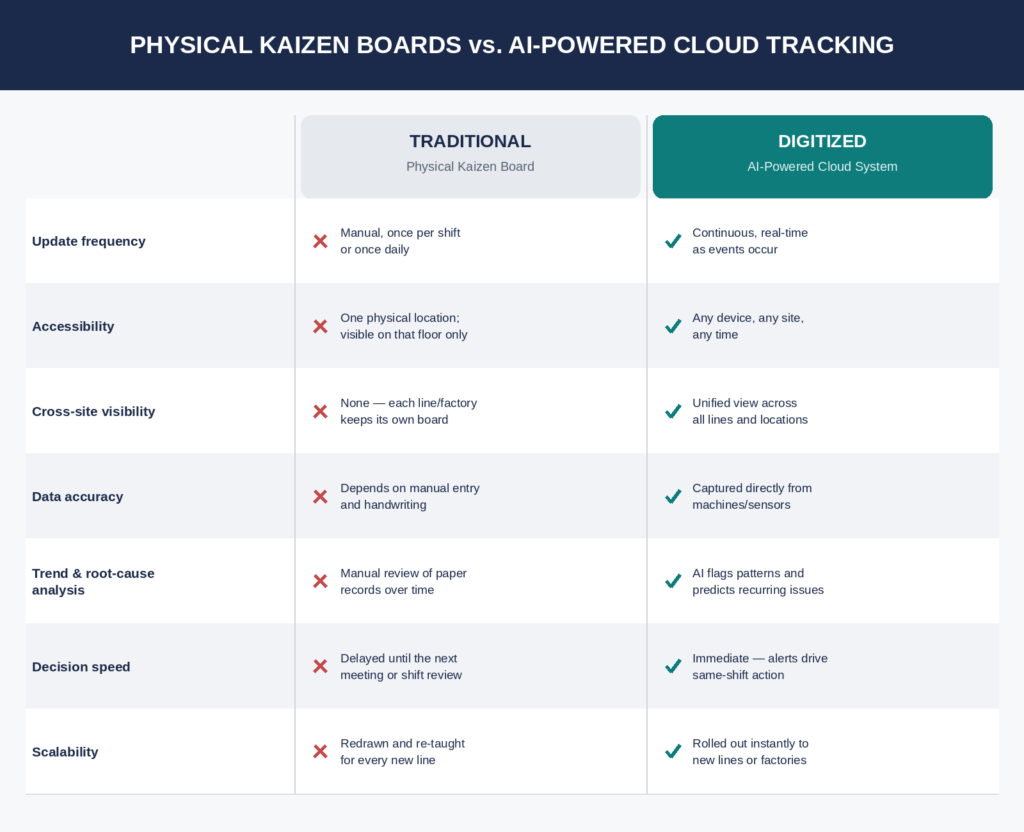
Kaizen has traditionally been taught and adopted worldwide to achieve business stability and continuous improvement. Kaizen in Manufacturing was traditionally supported by a huddle board on the floor or in a project room. Which is followed by data collection, gap identification, a vision for the future, and an implementation plan. It has been effective in the process of improvement for many years, and there is no doubt about it. But today, there are tremendous changes in the world, and it is time to change old practices as well. Today, the race is about time: solutions are analyzed faster and decisions are made faster. Also the assessment of the requirement is correct, and solutions are executed faster. Nowadays, customers require agility and speed, which means that they need to shorten decision-making time. Which provide a quick response to them.
Physical Kaizen boards and papers have a limited scope of analysis. A lot of time is required to draw trends and data tables for analysis. They cannot analyze multiple domains or multiple problems at the same time. Also they cannot directly lead to the point where and when a problem occurs. For this type of situation, the physical Kaizen board idea was great, but it wasn’t made for it in reality.
Industry 4.0 is changing this. Sensors, cloud platforms, and artificial intelligence are turning Kaizen from a local, paper-based ritual into a connected, real-time management system. This isn’t about replacing the philosophy of Kaizen—small, continuous, team-driven improvement is still the goal. What’s changing is the infrastructure underneath it. It’s not the content that is changing. But how data is captured, who see it, and how fast a factory act on it.
Why Traditional Kaizen Boards and Paper Are Becoming Outdated
The typical Kaizen board is a colorful board with information that is, at best, a day old when it is manually updated. It will only cause a review by a manager or leadership when they visit the board or when a person collates and reports on all the Kaizen boards being collated from the factory. This is a drawback that would become a problem if the company expanded into multiple locations. The numbers are handwritten, and therefore, the quality of the numbers depends entirely on the discipline of the person(s) filling them in that day.
This is not to condemn the individuals who use the board or the process, but rather to identify a setback in the mechanism. Paper and whiteboards are not meant for carrying information across space or time. That’s where Industry 4.0 technology comes into play.
Kaizen in Manufacturing Through IoT and Industry 4.0
Digitizing Kaizen is linking the same mindset of continuous improvement to a set of technologies that were not available to previous generations of industrial engineers. An understanding of the following technologies is important in a manufacturing environment:
Cloud-Based Access to Manufacturing Data
IoT devices are installed in machines, gathering data for every production cycle, quality standard, downtime event, changeover time, performance metric, and more, without anyone having to wander the floor with a clipboard.
IoT Devices for Automatic Data Collection
This data is stored in the cloud, meaning that it can be accessed from anywhere, including from the office, at home, or while traveling, via smartphones, laptops, or other devices.
AI-Powered Pattern and Bottleneck Detection
The AI models sit atop those data points, identifying patterns a human reviewer might not be able to notice for weeks. A bottleneck may recur at a specific frequency or cycle, or a defect type may be visible when a specific type of fabric is being used.
Whiteboards are replaced by digital dashboards that display live information about targets, progress, bottlenecks, top defects, leading causes of lost time, and past performance trends. This aids teams in knowing what they can do and whether the line performance is improving or moving in the right direction as planned. The data gets updated automatically via IoT devices, analyzed via cloud-based platforms, and displayed to enable real-time decisions, which saves time and offers flexibility beyond a traditional Kaizen board. This visibility can also be complemented by machine efficiency monitoring, which helps track performance and downtime in real time.

Digital Dashboards for Real-Time Visibility
Mobile connectivity implies that an alert is sent to a supervisor’s phone when a line slips below a target. Not at the next scheduled meeting. A mechanic will be alerted when a machine needs an urgent repair. Also a bottleneck can be escalated to management for repair.
Real-time data is used, to identify a production line that consistently fails to meet its target at a particular operation. Alert the relevant team, assign corrective action, and check if the performance at that operation improved after the change.
All these technologies cannot replace the judgment of the Kaizen team. They do the same thing by getting rid of the lag time. And also uncertainty between when something happens and when someone discovers it.
How Kaizen in Manufacturing Uses Real-Time Data Across Locations
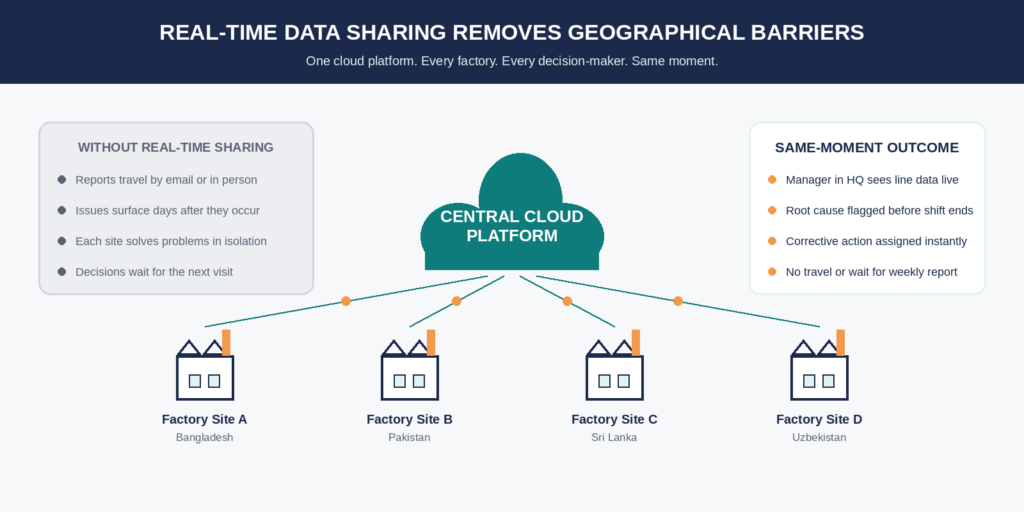
The old Kaizen mechanism is no longer relevant due to real-time data beyond boundaries. The data is accessible to anyone who requires a specific set of information and analytics. Whether they are on-site, at the head office, or visiting overseas. Its visualization is similar to what a line supervisor sees on the factory floor.
Another major advantage is that it gives an opportunity to take and implement action in real time. When it can still have an impact on the outcome. Rather than going back and studying data after an opportunity has passed. Post-event analysis is similar to a post-mortem after the event.
All decision-makers have access to the same data, information, and progress—there are no opportunities for miscommunication. By connecting teams with live production information, Kaizen in Manufacturing enables faster corrective actions across production lines, departments, and factory locations.
Challenges in Adopting Digital Kaizen
Of course, there are challenges to technology use, such as data security, initial costs, and, particularly, cultural issues. That need to be overcome over time and with training before people have confidence in a screen-based solution. These risks and challenges are all worthwhile when planning.
Closing Thought
Kaizen has always been about closing the gap between a problem occurring and the team acting on it. That’s the goal of Industry 4.0, and it’s the one that’s not going to change. It is not a discussion about the Kaizen process, but the basic concept and approach remain the same. It’s just about technology. Kaizen in manufacturing still involves teams going to the factory floor. This is the most critical part of staying in touch with production. Technology is just a means of accelerating decision-making and action when there is time to affect the day’s outcome.
Frequently Asked Questions
No. Digitalization does not necessarily eliminate visual boards. Digital dashboards can replace or complement physical boards by providing live information, wider accessibility, and automatic updates while preserving visual management.
No. Technology does not replace the Kaizen philosophy of small, continuous, team-driven improvement. It strengthens the process by providing faster data collection, clearer analysis, and quicker communication.
Cloud-based IoT systems can face risks such as unauthorized access, data leakage, weak device security, and unreliable network connections. Manufacturers should plan for access controls, encryption, secure device configuration, regular backups, and employee training before implementation.