
We sometimes see many factories presenting screens with appealing graphs, trends, and analytics to visitors and buyers. In the reception area, colorful dashboards and reports are displayed. A digital room shows the company’s insights, where buyers are impressed to see this digital version of the company. Then, the company becomes famous through testimonials and buyers’ reports.
However, if you go to the same company’s shop floor and ask the managers or supervisors, “How do these digital solutions make your life easier?” and the answer is just silence, then it will clearly tell you whether that project was meant for productivity or just for show.
This is the loophole in digital projects that many leaders unintentionally overlook or avoid during project planning. It is one of the digital transformation challenges that can turn a promising investment into a showcase rather than a productivity improvement.
The Showroom Syndrome
I call it showroom syndrome. A company purchases a digital platform just because its competitors have it, customers demand Industry 4.0 after an audit, or simply because the board thinks it should look modern. Then, that project gets a name, a specific launch date, and a proper ceremony. What it is unable to answer are the most basic questions in management: What problem are we going to solve, and how will we know whether the problem is solved or not? How will it help users in their daily routines?
It’s perfectly reasonable to expect that the soft side of it—the buyers’ interest in traceability, transparency, and modern systems—is a benefit. We mistake these soft benefits for the only major concerns and do not link them to user performance. An image is a by-product of a successful digital project. It should NOT be the aim. If it is, the money is gone, the cost per unit does not change, the defect rate remains the same, and on-time delivery does not improve.
Two Definitions of Success
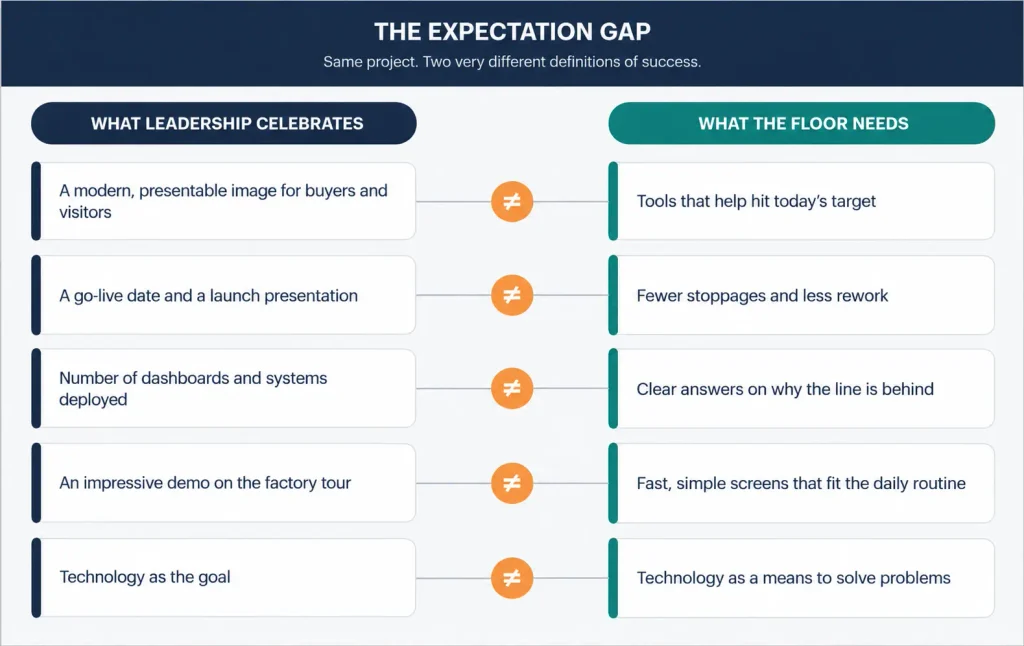
There is a major difference in the definition of success between the production manager and leadership. The company’s leadership defines the success of a project in terms of its timely completion, deployment quality, and visibility. On the other hand, the production manager defines it in terms of its impact on performance and practicality.
Neither group is right nor wrong. They are answering different questions because no one sat them down at the beginning to agree on one. Most digital transformation projects fail long before they reach the point of technology issues, at the point where expectations are not aligned. These digital transformation challenges often begin with different expectations of what success should look like.
What the Floor Pays for Leadership’s Choices
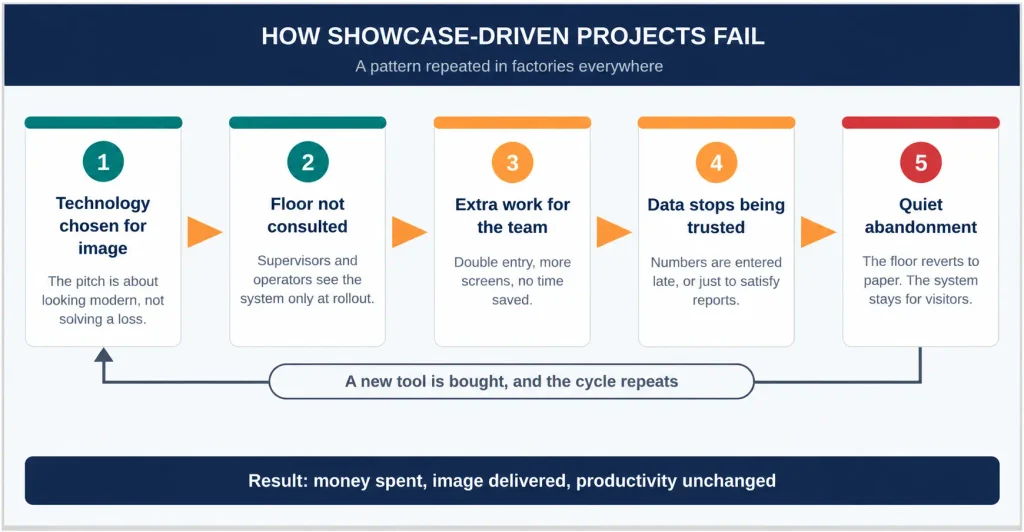
When a digital project is chosen without user feedback or without considering user needs, its fate can be predicted. The operators who were measured on output are now required to scan, tap, and log at every stage, with no extra time provided. The same numbers are entered by supervisors in the new system and in the old register, since the old register is what their manager still requires. Screens don’t provide guidance on problems occurring, root causes, or preventive plans, so no one is interested in keeping them active.
The floor returns to paper and personal experience. When users don’t feel the solution is helping them in their jobs, they simply stop using it and go back to paperwork. Hence, digital platforms die without any technical reasons. The platform continues to operate and keeps impressing visitors. Leadership assumes progress from the live dashboard. The floor is a theater, and it knows it. This can’t be considered resistance to change because it is a natural reaction to a change that is not helping a team improve outcomes but is making their work more difficult.
Why Smart Leaders Fall into the Trap
This is rarely about bad intent. Leaders face real pressure: customers ask for digital capability, competitors announce new systems, and vendors present polished demos with impressive promises. A visible project is easy to defend in a board meeting, while a quiet improvement in changeover time is not. Vendors also sell features, not outcomes, so the conversation drifts toward what the system can do rather than what the factory needs to do.
Five Questions Every Leader Should Answer Before Signing
If you are about to approve a digital transformation project, answer these questions first. If you cannot, the project is not ready. Answering them can help address digital transformation challenges before they affect implementation and productivity.
- What specific loss are we attacking? Name it in hours, defects, waiting time, or money. “Becoming digital” is not a loss.
- What will change on the floor, and who will feel it first? If you cannot describe a supervisor’s daily routine after go-live, you have not designed the project.
- How much work does this add, and what does it remove? Every new data entry must be paid for by a task that disappears.
- Which number will prove this worked? One KPI, with a baseline, a target, and a date.
- Who on the floor helped choose and design this? If the answer is nobody, expect the project to fail quietly.
What a Purpose-First Project Looks Like
A project built around productivity starts in a different place. It begins with a problem the floor already feels: a line waiting for material, a changeover that takes too long, a defect that keeps escaping to the end of the line, or a bottleneck nobody can see until the day is over. Digitization is then chosen because it can make that problem visible sooner or solve it with better data, not because the technology happens to be available.
From there, the roadmap is simple and disciplined. Define the problem. Set one measurable outcome with a baseline and a date. Co-design the solution with the supervisors and operators who will live with it. Pilot on a single line and compare against the baseline before spending more. Scale only what has proven its value and review the gains every month. Each step ends with something that can be checked, which is exactly what a showcase project avoids.

Data Is a Problem-Solving Tool, Not a Decoration
The real promise of digital systems and data analytics is not prettier reports. It is a shorter time between a problem happening and a team understanding it. A dashboard that shows hourly output against takt time tells a supervisor in the first hour that the line is falling behind, not at the end of the shift. Loss-time data grouped by cause tells an industrial engineer where to focus on the next improvement. Defect data tied to a station tells quality where the process is leaking. In each case, technology serves a person who has a problem to solve.
That is the test. Does a specific person on the floor make a better or faster decision because of this screen? When the answer is yes, alignment follows naturally. Management gets measurable gains in efficiency and profit. The floor gets support in the work it already does. The same project satisfies both because both were defined together at the start.
The Challenge to Leadership
Digital transformation is not a problem. Digital transformation without a purpose is. Overcoming digital transformation challenges starts with defining the outcomes that actually matter. If the main outcome you want is a better impression, a presentation will achieve it for far less money. If you want higher efficiency, lower waste, and better profit, then be honest about it, write it down, measure it, and build the project with the people who will carry it out every day.
The factory floor does not need a modern image. It needs tools that help it win the day. Give them those, and the image will take care of itself.
The biggest digital transformation challenges include unclear objectives, poor employee adoption, disconnected systems, additional workloads, and a lack of measurable outcomes.
Digital transformation projects often fail when companies focus on technology and impressive dashboards rather than solving real production problems, involving shop-floor teams, and improving operational performance.
Manufacturers can overcome these challenges by identifying specific production problems, involving employees, setting measurable KPIs, testing solutions on a small scale, and expanding only after achieving proven results.